Gathering your registered entity names, working draft filenames, and governing-law assumptions before you open Orbid intake separates a clean fixed-fee Matter Pack quote from days of pre-engagement clarification emails. Forwarding unlabeled folders without corporate registration details or version tags forces any outside advisor to reconstruct basic deal mechanics before reading a single commercial clause.
Orbid operates as an AI-native law firm focused on cross-border business, separating intake structuring from legal sign-off. Orbid uses AI-assisted extraction and comparison to organize your corridor, entities, filenames, language posture, and price-change triggers into a bounded Matter Pack built from fixed-fee module units at zero scoping cost, while licensed local counsel in the destination market confirm the scope and fixed fee, review the agreed contracts, and carry independent professional responsibility. AI never provides legal advice.
Assemble six baseline inputs before opening intake
Orbid's scoping engine follows five core coordinates: origin market, destination market, matter category, plain-language project summary, and exact document filenames. In intake, Origin marks where your contracting group operates from, while Destination marks the jurisdiction whose local statutes or commercial environment govern the review. Thailand and Germany run as live corridors today with active local review delivery, while listed corridors (Singapore, Vietnam, Malaysia, Indonesia, the Philippines, and the United States) accept scoping requests with local counsel availability and timing confirmed per matter before you approve paid work.

Answering six baseline questions in a scratch note before starting intake removes almost every pre-quote clarification loop:
- Record each party's exact registered legal entity name, jurisdiction of incorporation, and deal role (such as disclosing IP owner, OEM manufacturer, distributor, or data processor). Skip consumer brands and group trade names that do not appear on the signature block.
- Summarize the commercial objective, current negotiation stage (pre-draft RFQ, term sheet signed, counterparty template received, or round-two redline), and the concrete business decisions the review must support.
- Tag the exact working filename and version label you want reviewed alongside all referenced schedules, underlying master agreements, and prior signed NDAs so counsel never prices an obsolete attachment.
- Separate settled commercial terms (pricing mechanics, payment milestones, Incoterms, territory limits, exclusivity, minimum volumes, and initial term) from open negotiation points.
- State the draft language, the negotiation language, whether dual-column text exists or translation is needed, and your target closing window, noting that final delivery timing is confirmed inside the Matter Pack.
- Name the internal executive or Legal Ops lead authorized to approve the Matter Pack scope and fixed price before billable work starts.
Sequence your cross-border contract stack from NDA to exit
Reviewing commercial agreements out of sequence creates contradictory obligations across annexes and forces paid rework. Walk through five stages to decide which contract belongs in your first Matter Pack and which sits in Phase 2.
Lock pre-deal confidentiality and non-use before sharing specs
Execute cross-border confidentiality agreements before transmitting CAD drawings for factory quotes, sharing margin models with prospective distributors, or running technical architecture demos. Match the agreement to the direction and risk of your disclosures. One-way NDAs fit unilateral disclosures, while mutual NDAs fit two-way diligence where a regional distributor shares customer lists against your product roadmap. Before OEM or ODM quoting, insist on a non-use NDA that bars the factory from building competing goods from your know-how rather than stopping third-party leaks alone, and use compact unilateral undertakings when site-tour interpreters or introducers decline long-form contracts.
Treat Letters of Intent, Memoranda of Understanding, and Term Sheets with equal care. Document titles never decide enforceability; "non-binding" LOIs often contain binding islands governing exclusivity windows, confidentiality, governing law, and cost allocation. Flag which clauses you intend to bind before local counsel reviews the draft.
Separate IP and know-how licences from reseller boilerplate
Moving from discovery into manufacturing, licensing, or co-development requires dedicated IP and technology transfer contracts rather than a casual logo clause tucked inside a sales contract. Clarify four boundaries in your intake notes: whether a partner needs narrow marketing brand display or a royalty-bearing trademark licence; whether transfers cover registered territorial patents or unpatented production know-how; whether software engineering runs as commissioned work-for-hire or joint R&D requiring a clean split between background IP and foreground IP; and whether destination statutes impose local technology-transfer registration (as in Vietnam) or franchise registration rules (as in Malaysia).
Anchor the commercial MSA, channel, or OEM supply core
Once confidentiality and IP boundaries hold, scope the revenue or supply contract matching how money and goods move. Whenever you submit a new Statement of Work or SaaS Order Form, attach the parent Master Services Agreement because liability caps, indemnities, and acceptance remedies live in the parent text. On channel deals, separate title-taking resellers from commission-earning commercial agents where destination statutes attach mandatory post-termination indemnity claims. On factory supply deals, state whether the supplier builds your design (OEM) or adapts its own platform (ODM), and list Incoterms, defect rejection windows, and tooling ownership alongside your upstream non-use NDA.
Pair DPAs with cross-border transfer mechanisms
Enterprise procurement and privacy statutes across Europe, Singapore, Thailand, and the United States stall signature whenever teams lump privacy into one generic clause. Scoping cross-border data privacy agreements separates processor Data Processing Agreements, controller-to-controller data sharing contracts, and cross-border transfer instruments such as EU 2021/914 Standard Contractual Clauses or transfer obligations under Singapore's PDPA. Gather your live subprocessor list and verify that promised incident-reporting hours and security controls match what your engineering team runs in production.
Align governing law and arbitration seats across the stack
Signing an NDA under Singapore law with SIAC arbitration, a distribution contract under local courts, and a side letter with no forum clause invites parallel litigation if a relationship sours. Scoping dispute resolution and termination agreements requires recording governing law and arbitration seat (such as SIAC regional rules versus domestic arbitral institutions) as two distinct fields, and attaching the parent commercial contract whenever counsel reviews a termination, settlement, or release agreement so survival clauses close out without loose ends.
Deal-readiness matrix across five commercial stages

| Deal Stage | Files to Gather | Scoping Questions to Settle | Contract Category |
|---|---|---|---|
| Pre-deal discovery & RFQs | One-way, mutual, or non-use NDA, LOI/MOU, term sheet | Who discloses specs or know-how? Which LOI exclusivity or fee terms bind? | Confidentiality & pre-deal |
| IP, brand & engineering | Trademark/patent numbers, background IP list, licence or dev draft | Narrow brand display or full trademark licence? Who owns foreground repos? | Product, IP & technology |
| Commercial sales, channel & OEM | Parent MSA, SOW, SaaS order form, distribution or OEM/ODM draft | Exclusive territory? Which Incoterms, volume minimums, and tooling rules apply? | Sales, channel, or procurement |
| Personal data & security | Parent MSA, DPA, EU SCCs, subprocessor list, security schedule | Controller vs processor roles? Cross-border access? Realistic breach notice hours? | Data, privacy & security |
| Dispute forum & exit | Upstream contract, termination or settlement draft, release form | Do governing law and seat match across files? Which payment and IP duties survive? | Disputes & termination |
Copy-ready Matter Brief for the intake form
When you register or sign in at Orbid intake, submit your origin, destination, matter category, plain-language summary, and exact document filenames so Orbid can structure your Matter Pack and route it to selected licensed local counsel. Copy and adapt this template to get a crisp Matter Pack on the first pass:
| Specification Item | Agreed Value (Sample) |
|---|---|
| Corridor / Origin | Singapore |
| Corridor / Destination | Thailand |
| Corridor / Corridor status | Live corridor |
| Contract category | Confidentiality and pre-deal |
| Engagement model | Single Matter |
| Origin entity / Legal name | Acme Robotics Pte. Ltd. |
| Origin entity / Jurisdiction | Singapore |
| Origin entity / Role | Disclosing party and IP owner |
| Counterparty / Legal name | Siam Precision Manufacturing Co., Ltd. |
| Counterparty / Jurisdiction | Thailand |
| Counterparty / Role | Prospective OEM manufacturer |
| Business objective / Summary | Share CAD specs and firmware architecture for Q1 OEM production quote. |
| Business objective / Deal stage | Pre-quote discovery; counterparty sent bilingual NDA draft. |
| Key decisions needed | Verify non-use restrictions protect CAD drawings and test tooling; Confirm enforceability of English vs Thai prevailing language clause |
| Documents and versions / Working draft language | SiamPrecision_Mutual_NDA_v2_2026-11-10.docx |
| Related attachments | Schedule_A_Technical_Scope_Outline.pdf |
| Related attachments / New draft required | No |
| Related attachments / Translation required | No |
| Commercial and legal terms / Working language | Bilingual English / Thai |
| Commercial and legal terms / Negotiation language | English |
| Commercial and legal terms / Proposed governing law | Thailand (open to confirm) |
| Commercial and legal terms / Proposed dispute forum | SIAC arbitration in Singapore (open question) |
| Commercial and legal terms / Target completion date | 2026-12-02 |
| Open questions and scope triggers | Assess whether standalone non-use NDA beats amending counterparty mutual NDA; Exclude downstream OEM manufacturing agreement from this initial Matter Pack |
| Internal approver / Approver role | Operations Director |
| Internal approver / Approver contact | ops@acmerobotics.example |
Five intake bottlenecks that stall fixed-fee quotes
Clearing five preventable blind spots before clicking submit keeps your quote fast and accurate:
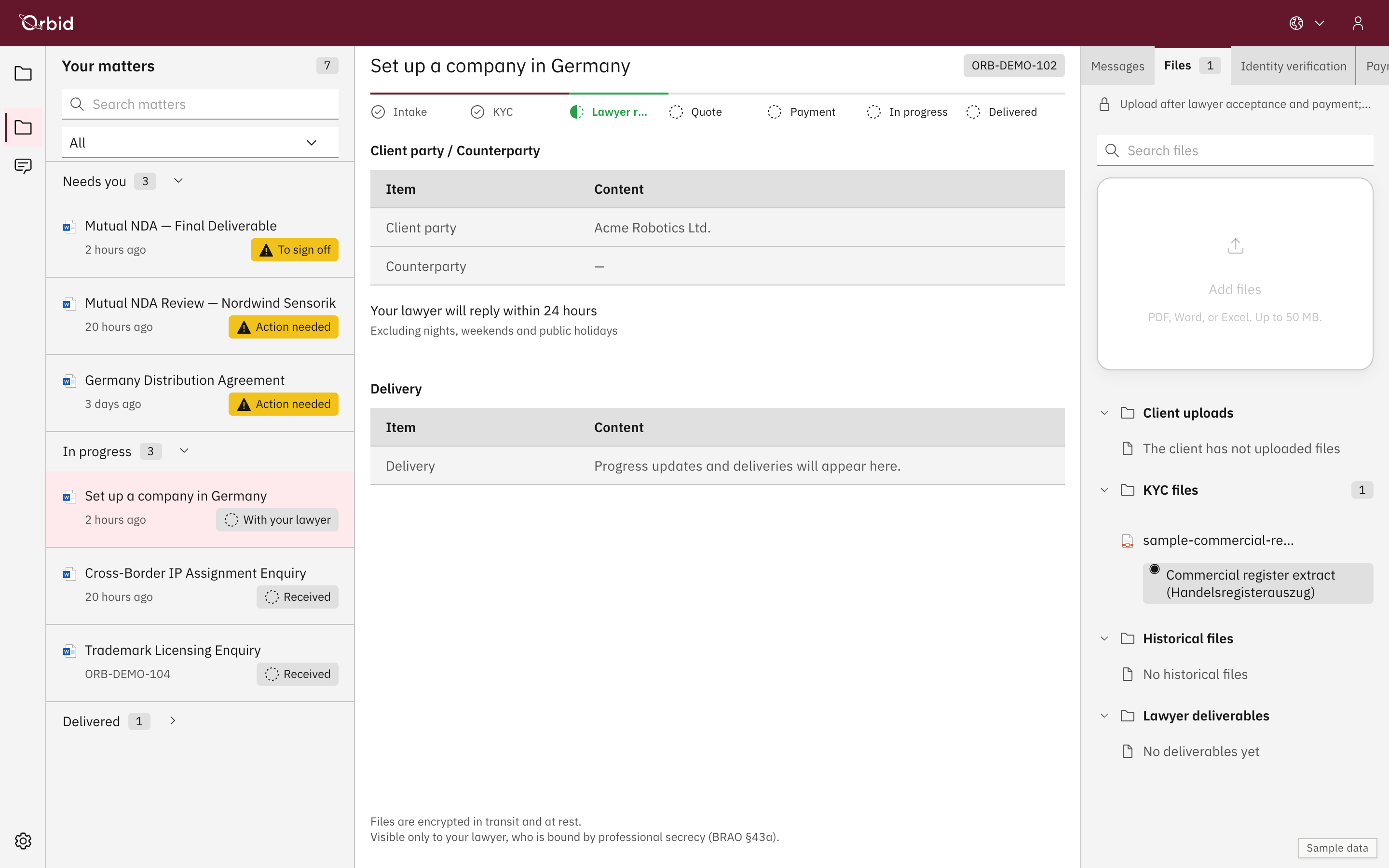
- Detached schedules and missing parent MSAs leave counsel blind to liability caps, indemnity carve-outs, and notice rules sitting in the umbrella contract; reference or include the parent text whenever scoping an SOW, DPA, or termination release.
- Silent prevailing-language clauses inside dual-column English/Thai or English/Chinese drafts force pre-quote clarification; state which column governs today and mark desired changes as open points.
- Informal brand names such as "Acme Europe" or "our Vietnam factory" block conflict checks; copy the exact registered entity name and country of incorporation from the signature block.
- Unlabeled file dumps (
NDA_final.docx,NDA_v2_clean.docx,NDA_partner_edits.pdf) obscure the baseline; tag one file as the working draft under review and label prior files as background context. - Waiting weeks for counterparty paper delays market entry; submit plain-language deal bullets early at Get my price to scope a fresh draft, knowing any later shift in partners, regulated products, or territories moves through an approved change order inside our cross-border contract review fixed-fee guide and APAC distribution and OEM scoping workflow.